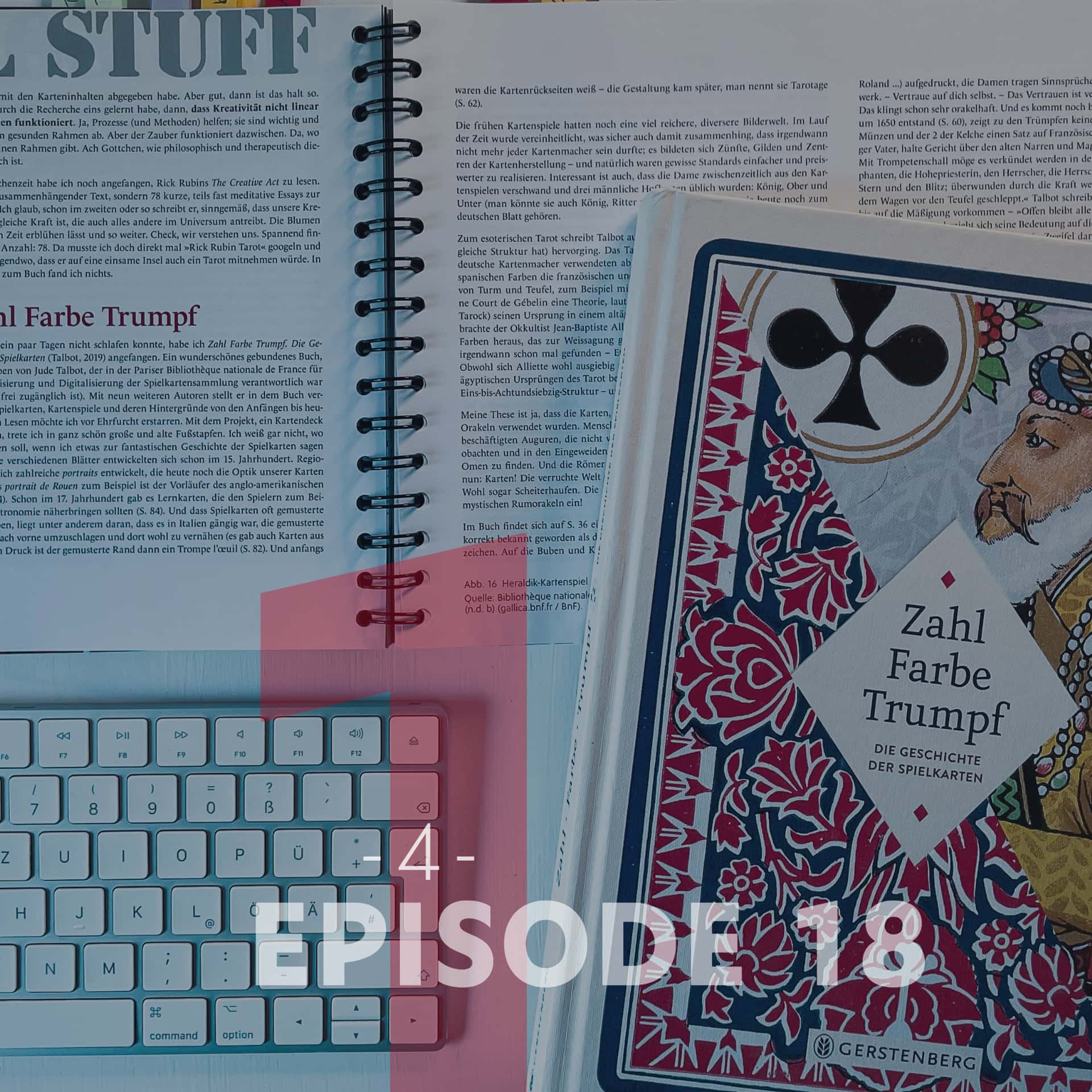
Now here’s an episode that I was really, really looking forward to publishing! 😍 So far I’ve been very much stuck in the world of tarot, but you might remember that I started to take a look at real playing cards in this episode.
Immediately fascinated I ordered a book on playing card history. And I can honestly say that it changed my life. And the course of this thesis.
In later chapters I will visit playing card collections / museums and become a member of The International Playing Card Society. All due to this book. I can’t praise it enough. So here’s an episode about it. 😉
(Plus some holy mountains and dogs. Just for good measure.)
Number Suit Trump
When I couldn’t sleep a few days ago, I started reading Number, Suit, Trump: The History of Playing Cards.
(That’s the literal translation of the German title Zahl Farbe Trumpf: Die Geschichte der Spielkarten. (Talbot, 2019) As far as I can see the book hasn’t been translated into English, it was originally published in French, see details below.)
A beautiful hardcover book edited by Jude Talbot, who was responsible for cataloging and digitizing the playing card collection at the Bibliothèque nationale de France in Paris (which is freely accessible online). Together with nine other authors, he presents various playing cards, card games, and their backgrounds from their beginnings to the present day. While reading, I almost freeze in awe. By taking on the project of designing a card deck, I’m stepping into some pretty big and ancient footsteps.
My favourite book – and yours, too?
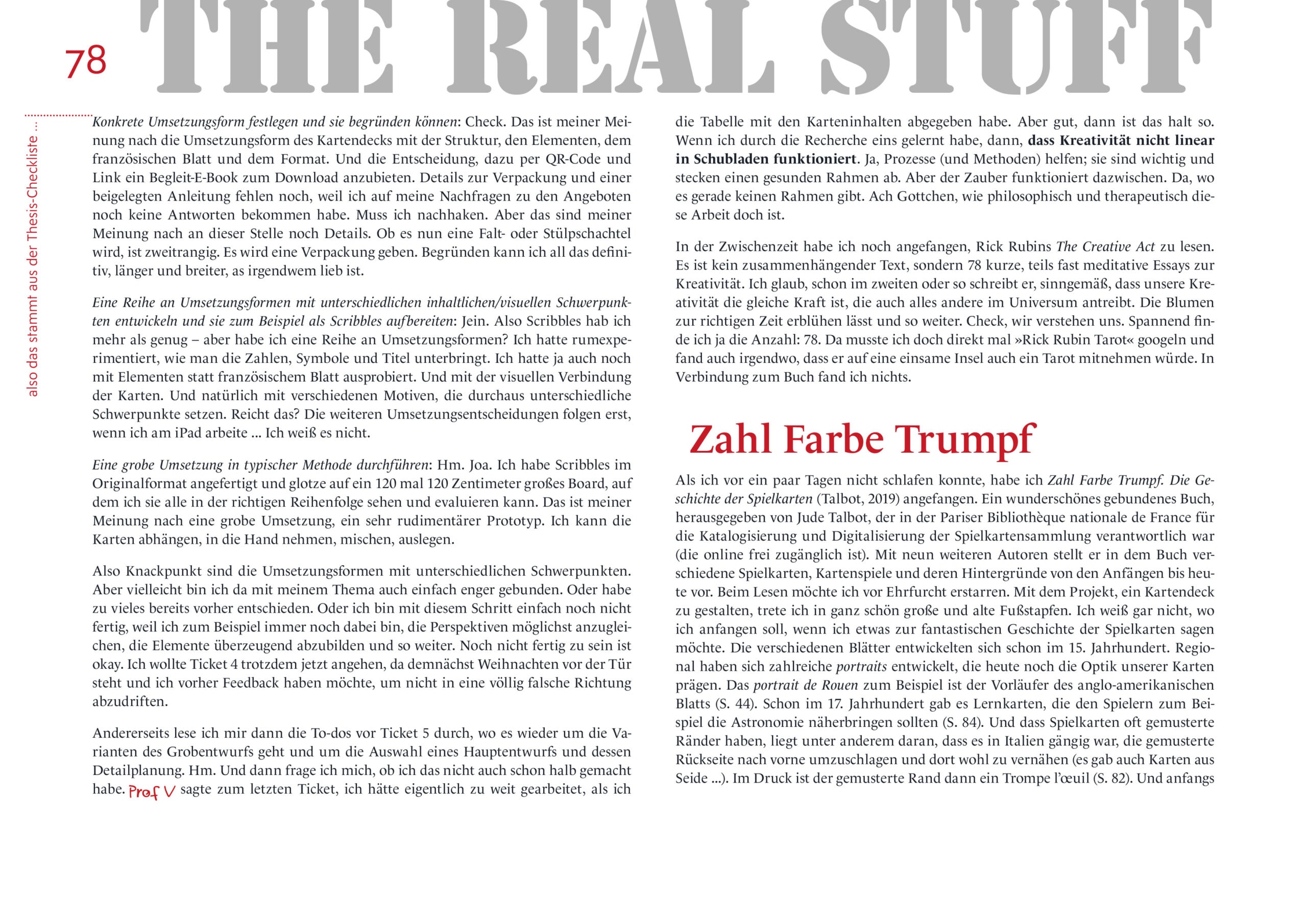
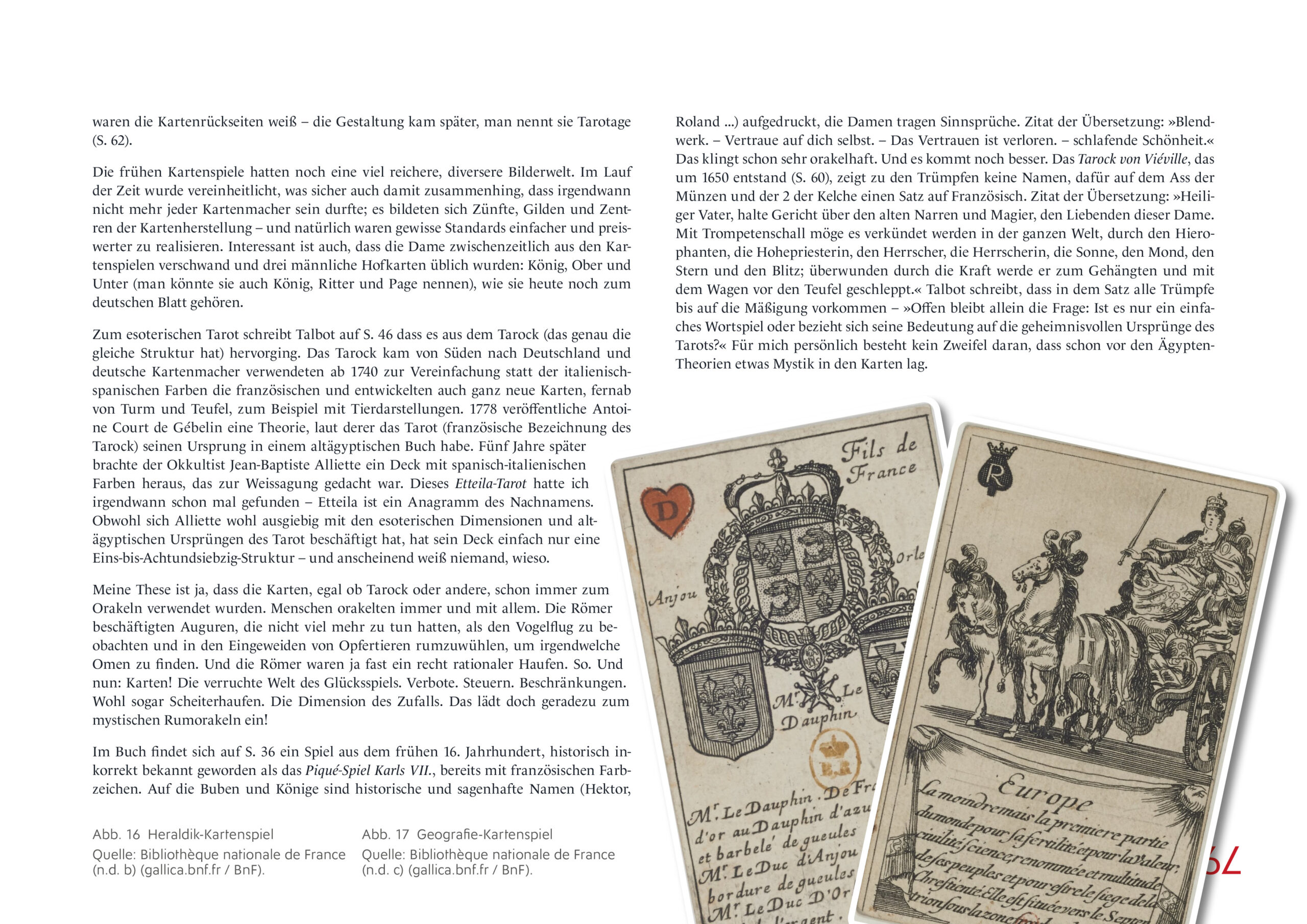
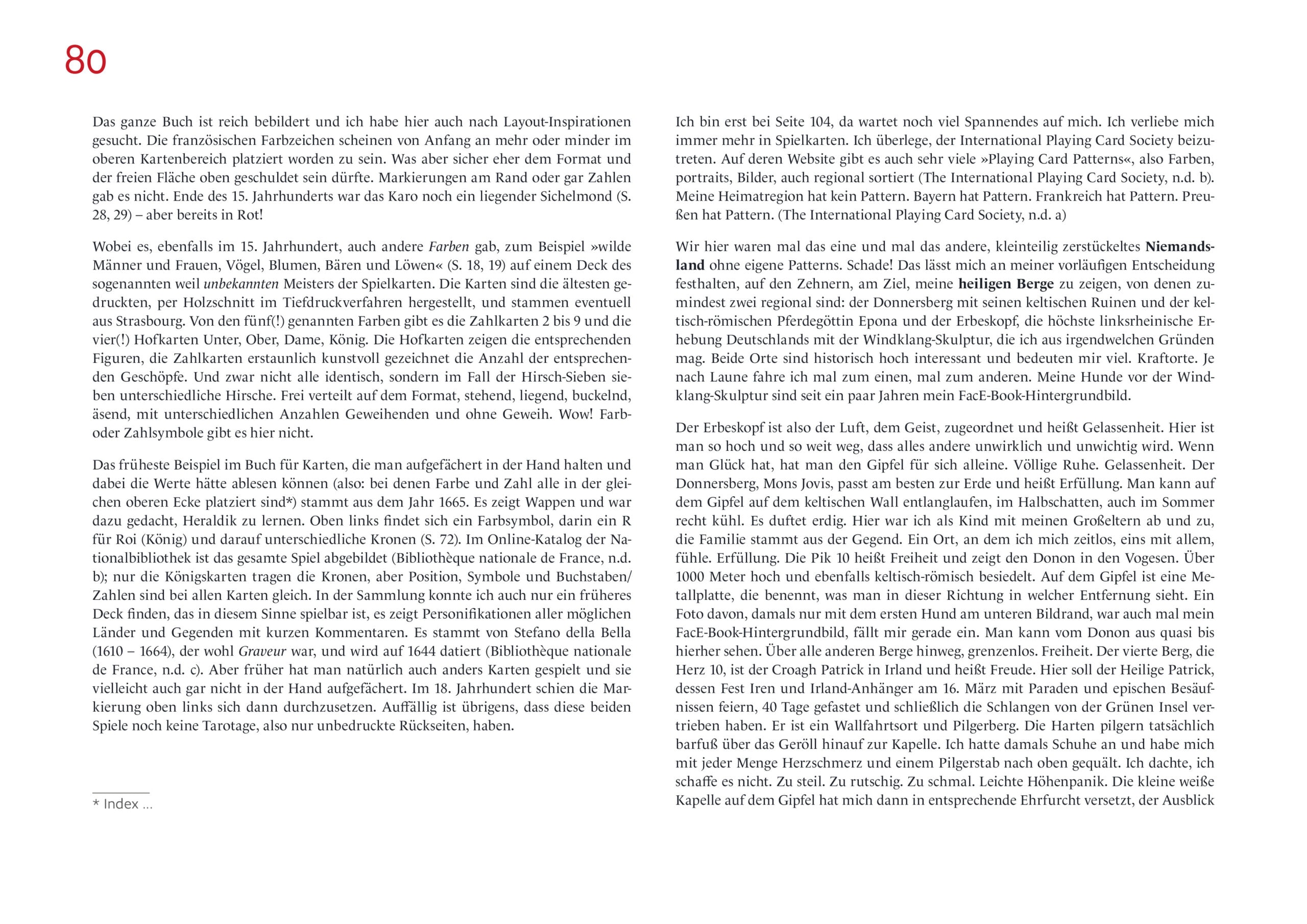
I have included some photos of Zahl Farbe Trumpf‘s pages here so that you can really see how beautiful it is (click to enlarge). I highly recommend you get a French or German copy. If you are remotely interested in playing cards, tarot cards, card history, cultural history, printmaking history, art and design history – this book is for you! 😍
Look for:
German edition: Zahl Farbe Trumpf: Die Geschichte der Spielkarten. Herausgeber: Jude Talbot; erschienen im Gerstenberg-Verlag, 2019.
French edition: Fabuleuses cartes à jouer: Le monde en miniature. Publiée sous la direction de Jude Talbot; Editeur: BnF Éditions, Gallimard, 2018.
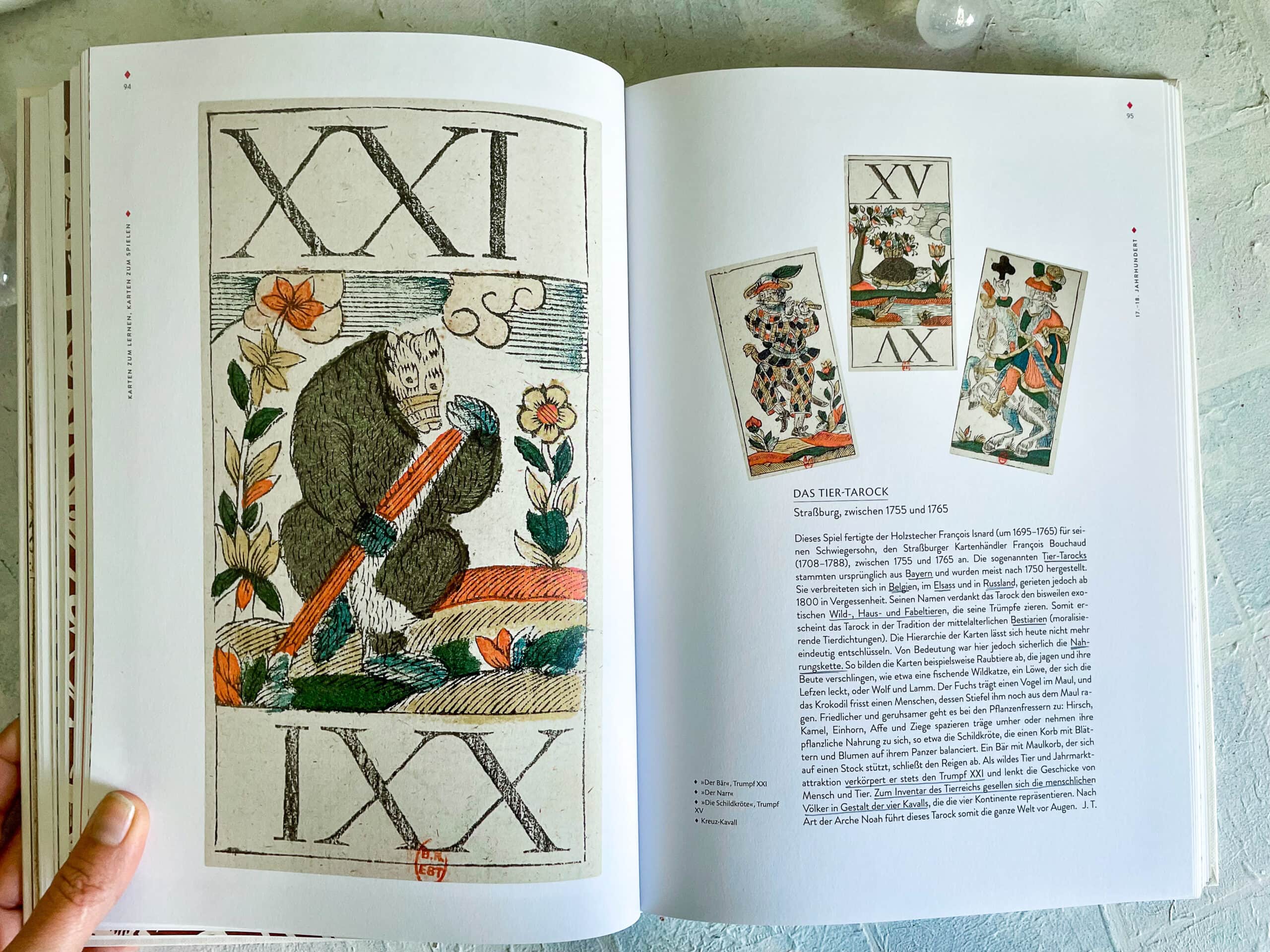
The beautiful Animal Tarock from Strasbourg, 18th century. Check out the Fool, left card on the right page.
I don’t even know where to begin if I want to say something about the fantastic history of playing cards. The various decks already began developing in the 15th century. Regionally, numerous portraits (patterns) evolved that still shape the look of our cards today. The portrait de Rouen, for example, is the predecessor to the Anglo-American deck (p. 44). As early as the 17th century, there were educational cards designed to teach players things like astronomy, for instance (p. 84). And the fact that playing cards often have patterned borders is partly because it was common in Italy to fold the patterned back over to the front and probably sew it there (there were even cards made of silk…). In print, the patterned border is then a trompe l’œil (p. 82). And initially, the backs of the cards were white – the designs came later; it’s called tarotage (p. 62).
Early card games had a much richer, more diverse visual world. Over time, things were standardized, which was surely also linked to the fact that eventually, not just anyone was allowed to be a cardmaker; guilds, associations, and centers of card production formed – and of course, certain standards were easier and cheaper to produce. It’s also interesting that the Queen temporarily disappeared from card games, and three male court cards became the norm: King, Ober (Over), and Unter (Under) (you could also call them King, Knight, and Page), just as they are still called in the German decks today.
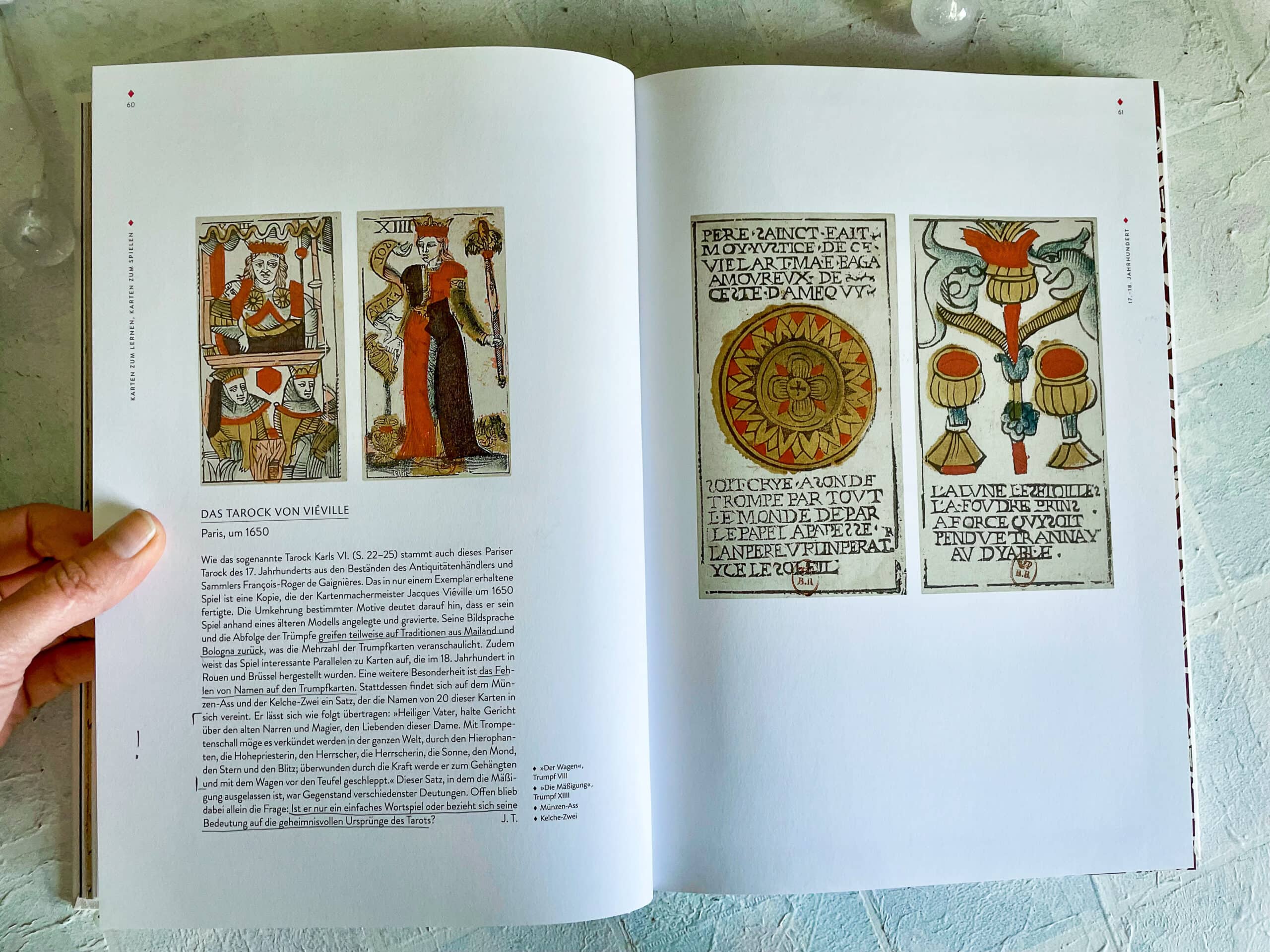
The Viéville Tarock, 1650, with the mystic sentence of the Ace of Coins and Two of Cups, quoted further down.
Regarding esoteric tarot, Talbot writes on p. 46 that it evolved from Tarock (which has the exact same structure). Tarock came to Germany from the south, and starting in 1740, to simplify things, German cardmakers used French suits instead of Italian-Spanish ones, and also developed entirely new cards, far removed from the Tower and the Devil, featuring animal illustrations, for example. In 1778, Antoine Court de Gébelin published a theory claiming that the tarot (the French name for Tarock) originated from an ancient Egyptian book. Five years later, the occultist Jean-Baptiste Alliette released a deck with Spanish-Italian suits intended for divination. I had already stumbled across this Etteilla Tarot at some point – Etteilla is an anagram of his last name. Even though Alliette apparently delved extensively into the esoteric dimensions and ancient Egyptian origins of tarot, his deck simply has a one-to-seventy-eight structure – and apparently, no one knows why.
My theory is that cards, whether Tarock or others, have always been used for fortune-telling. Humans have always practiced divination. With everything. The Romans employed augurs who didn’t have much more to do than observe the flight of birds and rummage around in the entrails of sacrificial animals to find omens of some sort. And the Romans were almost a pretty rational bunch. Well. And now: cards! The wicked world of gambling. Bans. Taxes. Restrictions. Probably even burnings at the stake. The dimension of chance. Tell me that doesn’t invite mystical fortune-telling!
Here’s the video:
On page 36 of the book, there is a deck from the early 16th century, historically inaccurately known as the Piquet deck of Charles VII, already featuring French suits. (There’s a photo further down.) Historical and mythical names (Hector, Roland…) are printed on the Jacks and Kings, while the Queens bear aphorisms. Quoting the translation: »Illusion. – Trust in yourself. – Trust is lost. – Sleeping Beauty.« That already sounds very oracle-like. And it gets even better. The Viéville Tarock (see photo further above), created around 1650 (p. 60), shows no names for the trumps, but instead features a sentence in French on the Ace of Coins and the 2 of Cups. Quoting the translation: »Holy Father, pass judgment on the old Fool and Magician, the lover of this Lady. With the sound of trumpets may it be proclaimed throughout the whole world, by the Hierophant, the High Priestess, the Emperor, the Empress, the Sun, the Moon, the Star, and the Lightning; overcome by Strength, may he become the Hanged Man and be dragged by the Chariot before the Devil.« Talbot writes that all the trumps except for Temperance appear in this sentence: »The only question that remains is: Is it just a simple play on words, or does its meaning relate to the mysterious origins of tarot?« For me personally, there is no doubt that there was already some mysticism in the cards even before the Egypt theories.
The whole book is richly illustrated, and I also looked for layout inspiration here. The French suit symbols seem to have been placed more or less in the upper area of the card from the very beginning. Though that was probably just due to the format and the empty space at the top. There were no markings on the edge or even numbers. At the end of the 15th century, the Diamond was still a horizontal crescent moon (p. 28, 29) – but already in red!
THE REAL STUFF
Mind you, also in the 15th century, there were other suits as well, for example »wild men and women, birds, flowers, bears, and lions« (p. 18, 19) on a deck by the so-called – because he remains unknown – Master of Playing Cards. These cards are the oldest printed ones, produced via woodcut in intaglio printing, and possibly originate from Strasbourg. Of the five(!) mentioned suits, there are the number cards 2 through 9 and the four(!) court cards Unter, Ober, Queen, and King. The court cards show the corresponding figures; the pip cards show the exact quantity of the corresponding creatures, drawn amazingly artfully. And not all identical, mind you, but in the case of the Seven of Stags, seven different stags. Freely distributed across the format, standing, lying, bucking, grazing, with different numbers of antler points and without antlers. Wow! There are no suit symbols or numbers here.
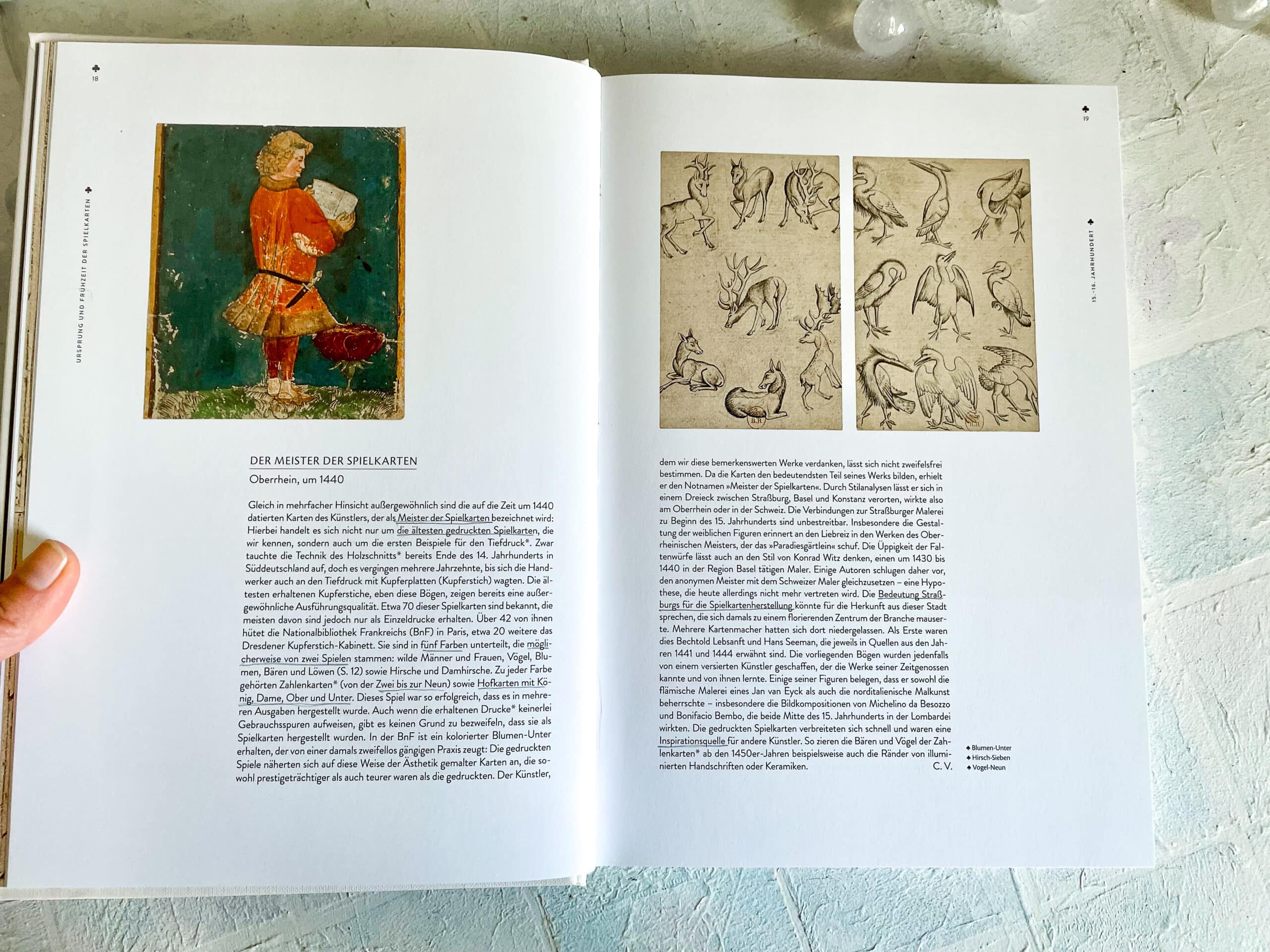
Check out the detail of the stags and birds! And keep in mind that this is artwork from the 15th century!
In the book, the earliest example of cards that you could hold fanned out in your hand and read the values (meaning: where suit and number are all placed in the same upper corner* dates back to 1665. It shows coats of arms and was intended for learning heraldry. In the top left, there is a suit symbol, inside it an R for Roi (King), and on top of that, various crowns (p. 72). The entire deck is pictured in the online catalog of the National Library (Bibliothèque nationale de France, n.d. b); only the King cards wear the crowns, but the position, symbols, and letters/numbers are the same on all cards. I was only able to find one earlier deck in the collection that is playable in this sense; it shows personifications of all sorts of countries and regions with short commentary. It was made by Stefano della Bella (1610 – 1664), who was likely an engraver, and is dated 1644 (Bibliothèque nationale de France, n.d. c). But of course, people played cards differently in the past, and maybe didn’t even fan them out in their hands at all. The top-left marking then seemed to establish itself in the 18th century. By the way, it’s noticeable that these two decks don’t have any tarotage yet, meaning just unprinted backs. (I’ve included pictures of these cards in the original documentation, see the »Original Pages« below.)
I’m only on page 104, so there’s a lot of exciting stuff still waiting for me. I am falling more and more in love with playing cards. I’m considering joining the International Playing Card Society. Their website also features a lot of »Playing Card Patterns« – meaning suits, portraits, images, also sorted regionally (The International Playing Card Society, n.d. b). My home region doesn’t have a pattern. Bavaria has a pattern. France has a pattern. Prussia has a pattern. (The International Playing Card Society, n.d. a)
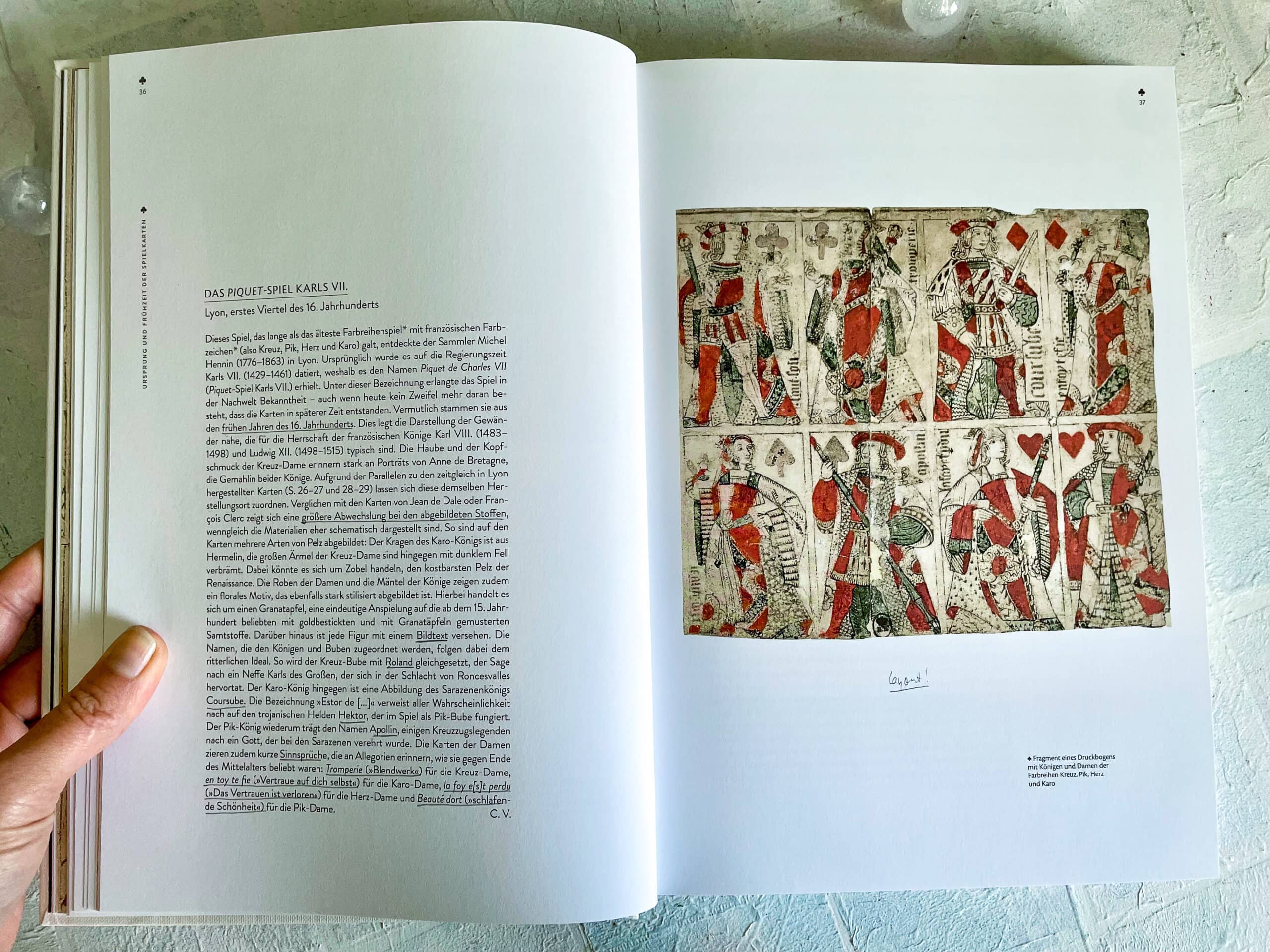
The Piquet Deck of Charles VII, 16th century.
* Index …
Holy Mountains. And Dogs.
Around here we were sometimes one thing, sometimes another, a heavily fragmented no man’s land without our own patterns. Too bad! This makes me stick to my earlier decision to show my holy mountains on the Tens, at the finish line, at least two of which are regional: the Donnersberg with its Celtic ruins and the Celtic-Roman horse goddess Epona, and the Erbeskopf, the highest peak in Germany on the left bank of the Rhine, featuring the Windklang sculpture, which I like for whatever reason. Both places are historically highly interesting and mean a lot to me. Places of power. Depending on my mood, I’ll drive out to one or the other. My dogs in front of the Windklang sculpture has been my Facebook cover photo for a few years now.
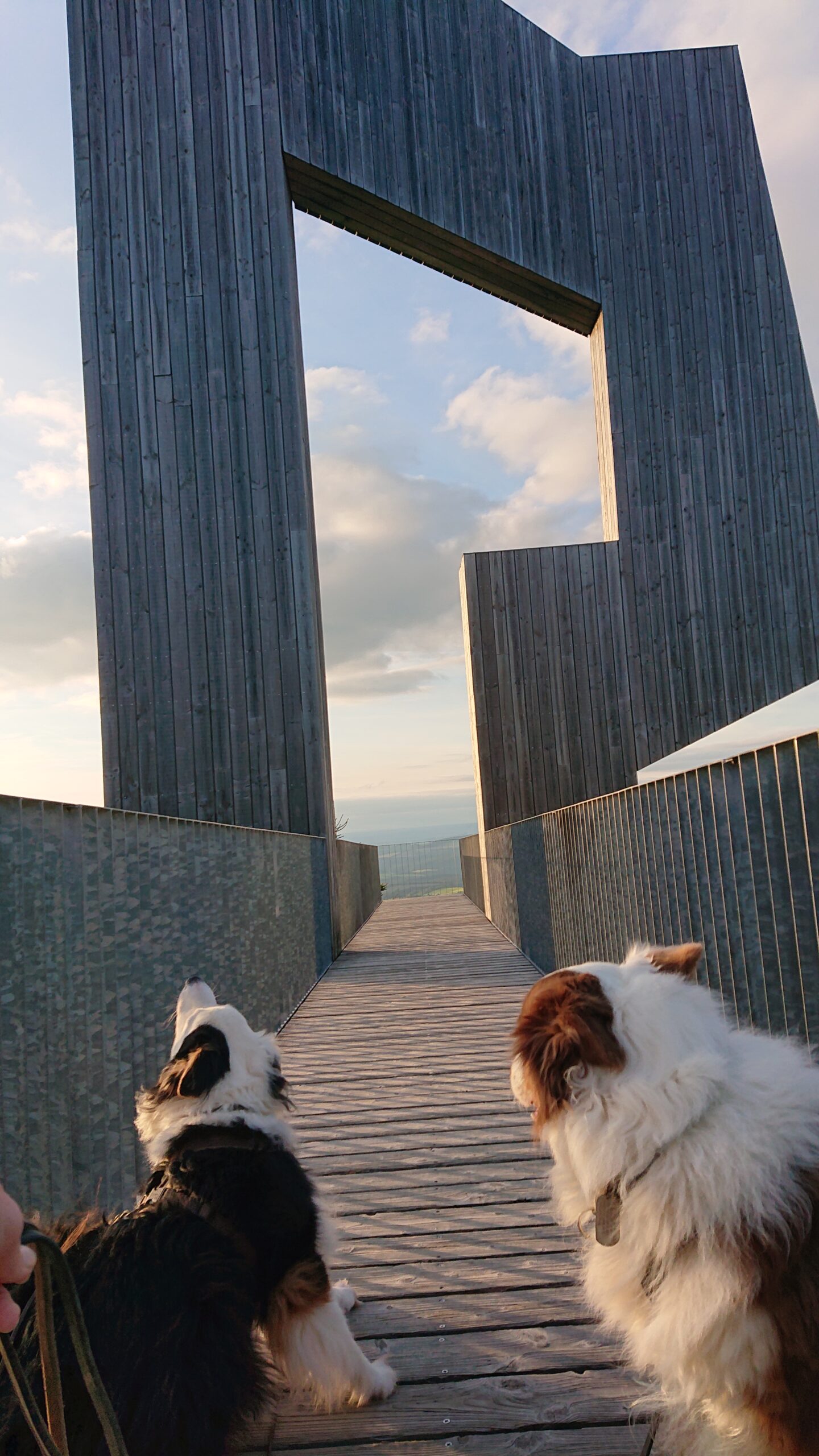
Excursion to the Windklang Sculpture on top of Erbeskopf
So the Erbeskopf is assigned to Air, to the mind, and is called Serenity. Up here, you’re so high up and so far away that everything else becomes unreal and unimportant. If you’re lucky, you have the summit to yourself. Complete peace. Serenity. The Donnersberg, Mons Jovis, fits best with Earth and is called Fulfillment. You can walk along the Celtic wall around the summit, in dappled shade, quite cool even in summer. It smells earthy. I was here with my grandparents from time to time as a kid; the family comes from the area. A place where I feel timeless, at one with everything. Fulfillment. The 10 of Spades is called Freedom and shows the Donon in the Vosges mountains. Over 1,000 meters high and also settled by the Celts and Romans. On the summit, there’s a metal plaque that identifies what you’re seeing in which direction and at what distance. A photo of that, back then just with my first dog at the bottom edge of the frame, was also my Facebook cover photo once, I just remembered. You can practically see all the way here from the Donon. Across all the other mountains, boundless. Freedom.

Holidays in France: The Donon
The fourth mountain, the 10 of Hearts, is Croagh Patrick in Ireland and is called Joy. This is where St. Patrick – whose feast day the Irish and Ireland fans celebrate on March 16th (its the 17th, but who cares?) with parades and epic binge-drinking – supposedly fasted for 40 days and finally drove the snakes off the Emerald Isle. It is a place of pilgrimage and a holy mountain. The hardcore folks actually pilgrimage barefoot over the scree up to the chapel. I had shoes on at the time and dragged myself up there with a whole lot of heartache and a walking stick. I didn’t think I’d make it. Too steep. Too slippery. Too narrow. Mild panic of heights. The little white chapel at the summit then filled me with proper awe, and the view of Clew Bay in the Atlantic, almost at the end of the world, moved me to tears. I’ve been carrying the keychain I bought in the visitor center on my keyring for about ten years now. Joy.
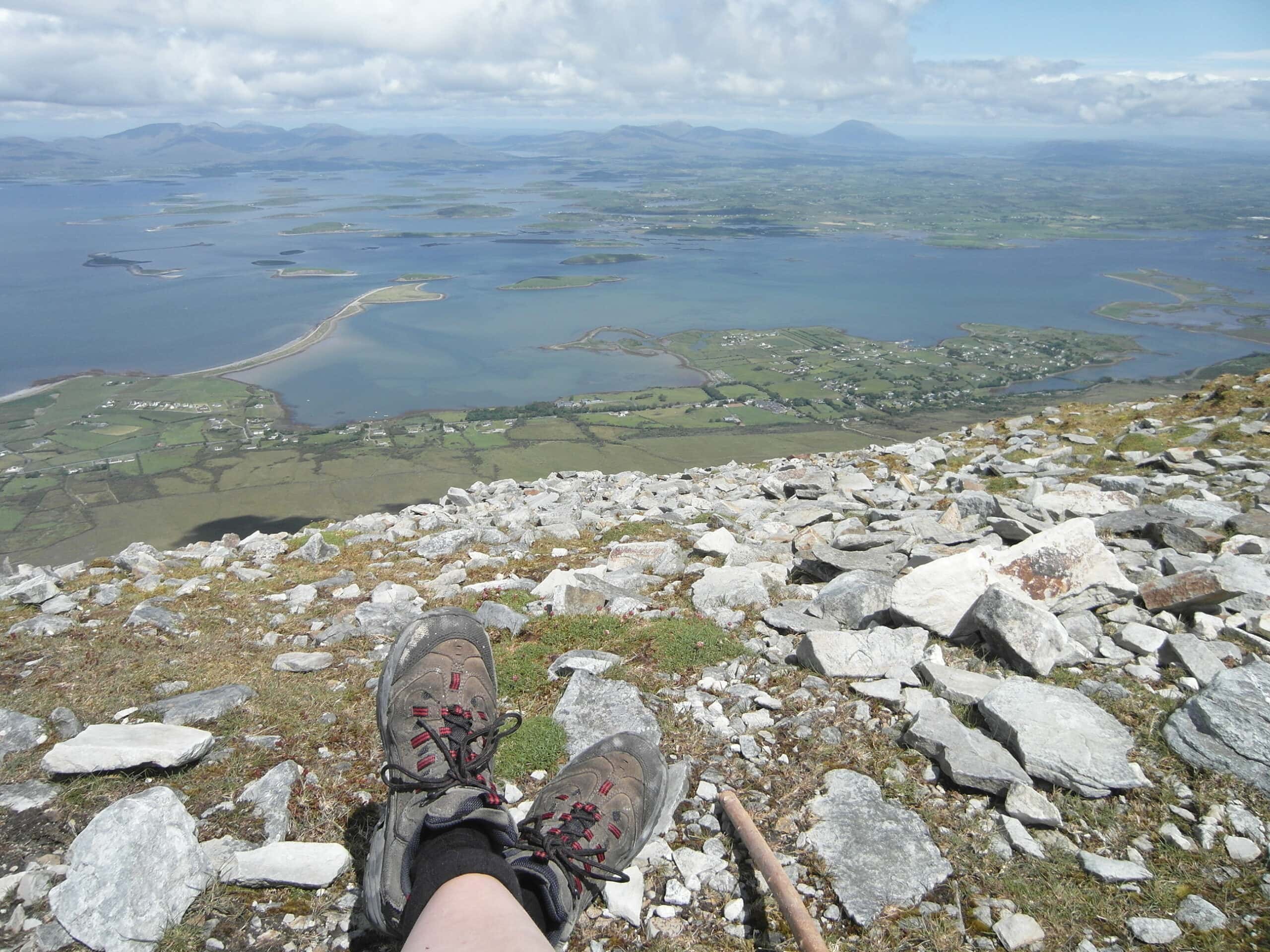
I made it to the top of Croagh Patrick in Ireland
Yes, the cards are allowed to (or should?) have a bit of a personal touch. I think it was with the mountain peaks that I came up with the idea about the perspectives. I honestly don’t remember. And so that they don’t all look the same, the four will be depicted in different seasons, in line with the German cards featuring the William Tell motifs, where each Daus shows a season. (»Playing card«, 2024)
So much for the history of playing cards. I’ve decided to visit a playing card collection. A few addresses are listed in the book’s appendix. The closest one is the Jean Dieudonné collection in Grevenmacher, Luxembourg; the second closest is the German Playing Card Museum in Leinfelden-Echterdingen. Everything else is so far away that I can’t leave the dogs alone. But maybe on the way to Normandy I’ll manage to hit the Collection Leber in Rouen or the Nationaal Museum van de Speelkaart in Turnhout at some point, who knows? Gather some inspiration. Sure, a membership in the International Playing Card Society sounds really nerdy … but … this project fulfills me so deeply that I find the thought of designing a deck for a thesis right now, and then just going back to business as usual and letting the cards be cards, unbearable. I hope that this deck will only be my first of many.
When I started the thesis, it was all about tarot and the »meaning« of the tarot cards – which usually means the Rider-Waite-Smith Tarot or Crowley’s Thoth Tarot. They might be the most widely used and certainly Waite and Crowley put a lot of thought into their cards’ meanings and worked with great artists.
BUT Number Suit Trump really put their achievements and omnipotence into perspective for me. Scroll back up and look at the decks shown in this book.
The modern tarot decks are standing on the shoulders of giants. The cards had meaning and amazing artwork long before Waite and Crowley.
We’ll get back to playing cards later in the Diary. But first it’s time for a nervous breakdown in the next episode – and the Fool will meet the Warden (or Hierophant / High Priest …) and cross The First Threshold.
I hope this episode helped you fall in love with playing cards. 😉 Leave a comment if you like!