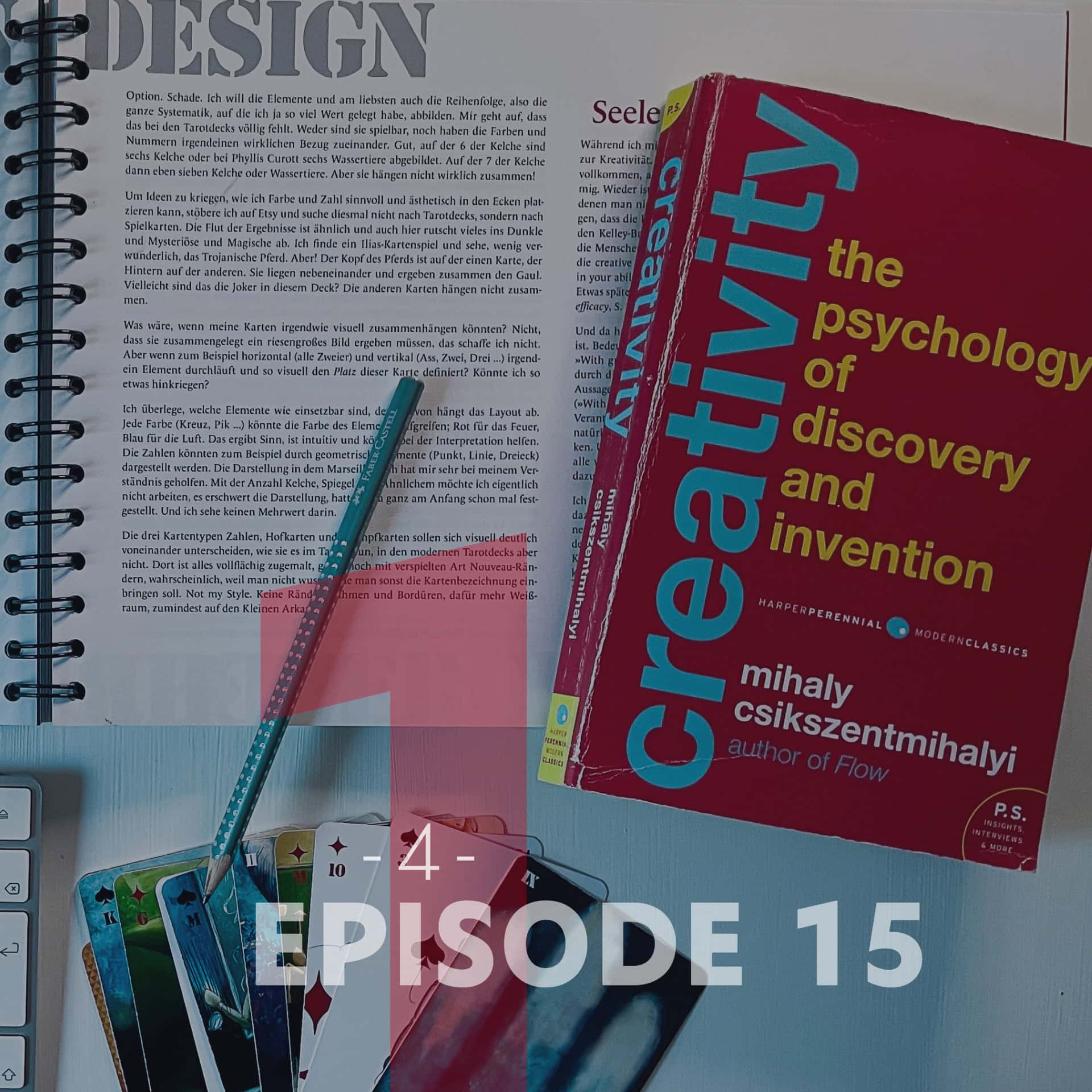
Finally: Chapter 4! In this episode I’ll take a first look at playing cards (muuuuch more on that later, this is just the beginning) and learn a bit more about creativity, especially from Miháli Csíkszentmihályi’s book Creativity.
The episode might not be deadly boring, but it isn’t too exciting either. Check out the video if you just want to listen to it instead of reading.
House of Cards
After Ticket 3, I’m thinking about the layout of my cards. I want them to actually be playable*, so the suit and value need to be placed in a way that I can easily recognize them when fanning the cards in my hand. During the Rummy duell last week, someone asked if they (the Shakespeare Cards, that is) were for left-handers. Suit and value are in the top left and bottom right corners. That’s how I’ve always known it. But just to be sure, I ask Google and look at some pictures while half-watching something trivial on a streaming site.
And just like that, it happens. I take a virtual dive into the history and visual world of European playing cards and get completely sucked in. There’s the top-left-bottom-right variant, and the one where they are marked in all four corners. Bans on playing cards prove beyond doubt that they already existed in Europe by the end of the 14th century. The fact that they were forbidden and later probably even burned at the stake makes perfect sense. Gambling.
The French suits of clubs, hearts, spades, and diamonds likely became an export hit because Lyon morphed into a stronghold of playing card production in the 16th century. But there are other decks, too. For instance, the German suits with acorns, leaves, hearts, and bells (which I’m familiar with but have never seen in real life) and – aha! – the Italian-Spanish (or Latin) suitsß with wands, cups, swords, and coins. So these suits didn’t originally belong to the realm of esotericism after all. I’ve already read in tarot books that they were historically assigned to the estates of the Middle Ages (peasants, clergy, nobility, bourgeoisie/merchants). (»Spielkarte«, 2024)
Even more exciting is the discovery that the characters on the universally known standard Skat cards actually depict real or mythical people. The King of Diamonds, for example, is Julius Caesar, and the Queen of Clubs with the sunflower is the Roman goddess Juno. A question I’ve been asking myself since childhood is finally answered. I pretty much grew up in pubs, and whenever I didn’t have my drawing stuff with me, I built houses of cards out of beer coasters or playing cards (wherever there was a regulars‘ table, there were cards), got lost in the little card pictures, and made up stories. Never would have thought I’d turn that into a Bachelor’s thesis one day …
Apparently, there have always been countless playing card designs inspired by the zeitgeist. I’m hardly surprised by Hindenburg and Zeppelin in the guise of Jacks. The biplane over the Seine and the German warships, on the other hand, I find a bit disturbing. Boosting morale through card games? I do find it interesting that in the German deck, the court cards Ober, Unter, and Daus (which I haven’t quite wrapped my head around yet) depict characters from Schiller’s William Tell alongside a season. (Anton, 2018)
* Did I write that down somewhere?
** OMG, this is where the card thing really took off. The circle had just closed – and Pandora’s box flew right back open.
Here’s the video where you can also see some cards:
And then there’s Tarock (or in French: Tarot). According to Wikipedia, the term refers to a whole series of similar card games I’ve never even heard of (Königrufen? Huh?). Their origins are traced back to the early 15th century in the Po Valley, and they were supposedly used for fortune-telling starting in the 18th century. Depending on the regional variant, the Tarock game features up to 22 trump cards, which are numbered with Roman numerals and aren’t assigned to any suit. (»Tarock«, 2024)
That the Tarock game is the predecessor to the mystical Tarot is a truism found in every tarot book. If you follow the history of tarot further, you eventually hit the assumption that it originated in ancient Egypt with its mysterious cults. And then came the Hermetic Order of the Golden Dawn, Waite, Crowley, and all the mystic stuff.
I think it’s very likely that both Tarock and other playing cards were simply used for fortune-telling at some point, somewhere. Thanks to superstition, bans, and burnings at the stake, there was always something obscure attached to cards anyway. And people have probably always believed they could see the future in something, even if it’s just coffee grounds and tea leaves. Besides, when you personify the court cards and assign social estates to the suits, you’re already giving them meaning and symbolism. That’s just how we humans are. Mystery solved.
So, what does this mean for my cards? I’m leaning toward scrapping my idea of sparks, mirrors, feathers, and tools. Too abstract, too weird. If I want to go back to the roots, I might as well just call them the Seven of Spades and the Eight of Diamonds. I like the French deck with its clarity. We just need to change something about the colors. In tournament Skat, the French suits with German colors are apparently common. But then Spades are green and Diamonds are orange. That corresponds zero with the elements and is absolutely not an option. What a shame! I want to represent the elements, and ideally the sequence too – the entire system I placed so much emphasis on. It dawns on me that this is completely missing in tarot decks. Not only are they unplayable, but the suits and numbers don’t really relate to each other either. Okay, sure, the 6 of Cups shows six cups, or in Phyllis Curott’s case, six water animals. And the 7 of Cups has seven cups or water animals. But they aren’t truly interconnected!
To get ideas on how I can place suit and number sensibly and aesthetically in the corners, I browse Etsy – this time looking for playing cards rather than tarot decks. The flood of results is similar, and here too, a lot of it slips into the dark, mysterious, and magical. I find an Iliad card game and spot, unsurprisingly, the Trojan Horse. But wait! The horse’s head is on one card, the rear end on the other. Placed side by side, they make up the whole horse. Maybe those are the jokers in this deck? The other cards don’t connect to one another.
What if my cards could somehow be visually interconnected? Not that they have to form one giant picture when laid out together – I couldn’t pull that off. But what if, for example, some element ran horizontally (all the twos) and vertically (Ace, Two, Three…), visually defining the place of that specific card? Could I manage something like that?
I’m thinking about which elements can be used how, because the layout depends on that. Each suit (Clubs, Spades …) could pick up the color of its corresponding element: red for fire, blue for air. That makes sense, is intuitive, and could help with interpretation. The numbers could be represented by geometric elements (point, line, triangle), for instance. The visual representation in the Marseille book really helped my understanding. I don’t really want to work with the exact number of cups, mirrors, or the like; it just makes the illustration more difficult, as I noted right at the beginning. Plus, I just don’t see any added value in it.
The three types of cards – pip cards, court cards, and trump cards – should be clearly visually distinct from one another, like they are in Tarock, but not in modern tarot decks. In those modern decks, the entire surface is painted over, often with playful Art Nouveau borders, probably because they didn’t know how else to incorporate the card names. Not my style. No edges, frames, or borders; instead, more white space, at least on the Minor Arcana.
PLAYING CARD DESIGN
Soul
While procrastinating on actually picking up a pencil, I keep reading about creativity. Julia Cameron’s The Artist’s Way completely thrills me for the first few pages, but once the actual program starts, I put it down. Disappointing. Dragged out. Once again, it talks about sort-of-divine forces that you just have to let flow, that you shouldn’t get in the way of. According to her, these are the same forces that make a flower bloom (Cameron, 2020, p. xix). I pick up Creative Confidence by the Kelley brothers. In the introduction, they write about the creative myth, which divides people and activities into creative and non-creative. They counter this with creative confidence: »At its core, creative confidence is about believing in your ability to create change in the world around you.« (Kelley & Kelley, 2015, p. 1,2) A bit later, the fitting psychological term drops: self-efficacy (p. 10).
And there we have it. Self-efficacy means that what I do has an effect. Which means: power. And somewhere, maybe Star Wars, I once heard the quote, »With great power comes great responsibility« (Okay, Wikipedia says the phrase was popularized by the Spider-Man movie with Tobey Maguire and points to other statements and stories in history conveying the same message. (»With great power comes great responsibility«, 2024)). Power, creative force, means responsibility. And imagining that we naturally carry this creative force –aka creativity – inside us and can wield it sounds more absurd than any cheesy fantasy novel. Making our will a reality (magic?) is basically what we all want, after all. And the possibility that we can actually do that, that we have the power to do it, is terrifying.*
I’ve come to the conclusion that we simply carry creativity, with everything that entails, naturally within us. I’d go so far as to call it the soul – yet another undefined term. Isn’t it our soul that fundamentally wants to realize itself? Much more, much stronger, than our ego? Isn’t it the artist’s soul that produces great masterpieces? And isn’t it our soul that can resonate, sing, or ache within us?
We humans aren’t the only creatures with a soul. To me, all creatures have one. The dogs happily snoring on my couch, just like the mulberry trees in my garden, or the wolf that recently claimed territory not too far from here. With the wolf, things are more instinctive. Eat, reproduce. My little tree lives entirely in the cycle of nature. It grows, bears fruit, sheds its leaves. Every single year. My dogs apparently already know things like anticipation, connection, and even boredom. By the way, the first time I consciously heard the term self-efficacy was in dog training.
So I agree with Cameron on this: The force that lets us create is ultimately the same one that makes the trees bloom. The soul. And I attribute that less and less to a god, and more simply to nature. Or more precisely: to evolution. Evolution is insanely creative. And it made sure that all living beings developed the necessary and appropriate traits, perceptions, and instincts. Otherwise, we might all have long necks, fins, and built-in sonar. And humans, without fur, without fins, without fangs, simply had to create in order to survive. Harness fire, build shelters. For that, I need wood; wood has to be moved from A to B. So eventually I invent the wheel. And so on.
And I’ll take it one step further: Just like with genetics and imprinting, we pass the soul on. We pour our heart’s blood into our work (In German, that’s the actual term for putting heart and soul into something: Herzblut reinstecken; putting your heart’s blood into something. Poetic, isn’t it?). That way, our artifacts somehow become ensouled too. Figuratively speaking, we feel this in gifts, heirlooms, and souvenirs that we subjectively attach emotional value to, regardless of their monetary worth. The item was ensouled by us, you could say.
Well, and just as the flower eventually blooms through a mix of soul and natural laws, volcanoes erupt, and maybe planets, stars, and galaxies orbit in this crazy universe. Maybe even Jupiter has a soul.
But back to us humans. My current theory is that we just naturally have a soul, as a result of evolution. Maybe, alongside our naturally existing creativity, it also includes our mind and our unconscious. Maybe that’s all the same. We have this soul, other living beings have this soul, and in my opinion, everything inanimate around us has it too, in its own specific form — and we pass our soul on to what we create and what we care for. This soul, if it keeps galaxies in balance, would have to be older than the ancient gods. So either there’s some overgod pulling the strings somewhere**, or … that’s just the way it is.
The point is: To me, creativity isn’t something divinely placed within us, something the muses whisper to us and that we then manifest or shouldn’t get in the way of.*** To me, just like the depths of the unconscious and, for all I care, intelligence – which is partly inherited and partly shaped (and which everyone possesses!) – it is simply a part of us that we have to deal with as best we can. We can utilize it or suppress it. The latter is easier because it comes with less power and less responsibility. But sadly, also less fulfillment. The path to fulfillment requires the use of creativity. If we fully tap into our creative potential, we can change and shape our world. And every single one of us has something valuable to contribute through our creativity. Even if we don’t know it yet.
I’ll keep researching on creativity and I have, who would’ve thought, ordered another book (apparently the only book) on the history of playing cards. Whether any of this will actually contribute to the result of this thesis, I have no idea. For the cards themselves, it’s irrelevant why my mulberry tree bears fruit and who was depicted on which card in the eighteenth century. But … it is important to me right now. And somehow it all flows into my practical work anyway – even if only as a soul.
* Actually, right now I’m leaning back toward the idea that maybe it isn’t our own will at all. Maybe we really are just vessels, helpers, who aren’t manifesting their own will. But we get chosen. Ah, more on that later, I won’t try to explain it here, it sounds like a cult … don’t panic, it’ll all make sense. Maybe
** Yes.
*** Or maybe it is. Perhaps a mix? Something inside us that resonates with the divine?
MORE RESEARCH
Complexity
I have to take notes while I read, otherwise it all just blurs together again. In between, I kept reading Creative Confidence, then ended up just skimming it. Design Thinking processes and a bit of psychology. I have never started and then abandoned so many books. Why? If I say »Because I already know all of this«, it sounds way more arrogant than I intend, and on top of that, it’s just wrong. But that’s kind of what it feels like. It’s all heading in the wrong direction somehow; sure, it validates a lot of my thoughts, but the groundbreaking epiphanies are missing.
So: Back to Csíkszentmihályi (2013). I had stopped reading on page 36 (yeah, made it really far …). There, he dives straight into the perceptions and instincts of animals. Did he copy from me? But instead of my soul theory, he writes that we additionally work with symbols. And the various symbolic worlds, from musical notation to mathematics, form the very domains in which creativity can emerge. Just a reminder that as soon as domains and fields are involved, Csíkszentmihályi is talking about Big-C and not my definition of creativity. He calls the knowledge of these symbols extrasomatic. Not inherited, but learned. (p. 36, 37)
Now, in the third chapter, it’s finally about the creative personality. Csíkszentmihályi names a certain genetic predisposition, for example, sensitivity to color and light in the case of the painter, as a facilitating factor. From this, interest can grow more easily. (p. 52)* Other factors are societal in nature again, but none of them are strictly necessary for someone to become creative. On page 56, he himself asks »When do we get to the interesting part«, the deep secrets of the creative personality – and explains that he doesn’t know if he can write much about it, because there simply isn’t just one creative trait.
But of course, he does anyway. I like the guy. On page 57, he reluctantly gives his answer: »If I had to express in one word what makes their personality different from others, it would be complexity. By this I mean that they show tendencies of thought and action that in most people are segregated. They contain contradictory extremes – instead of being an »individual«, each of them is a »multitude«. Like the color white that includes all the hues in the spectrum, they tend to bring together the entire range of human possibilities within themselves«. While all humans have these qualities, most only develop one of two poles, whereas creatives are more likely to develop both, he continues. He briefly touches on Jung and the repressed shadow, without acknowledging it we can never be complete, and clarifies that creatives aren’t »wishy-washy« or somewhere in the middle, but simply know and experience both extremes without inner conflict. (p. 57)
Whoa, now it gets exciting. Existing between, no, in two poles is something I’ve always considered my most characteristic trait. The conflict only ever arose because I thought, was convinced, that you could only be one thing. Cautious or risk-taking. Reserved or assertive. After all, that’s what all those personality tests ask – whether in the Bravo (that was THE teen magazine back in the days) or the psycho clinic – right? I thought this experience was normal. Or that maybe I do have schizophrenic traits, or just don’t really want to commit to how or what I am. My life got a bit more relaxed when I eventually thought, »Fine then, I’m a freak.«
Goethe comes to mind. »Rejoicing to the heavens, grieving unto death; happy alone is the soul that loves.« There it is again, the soul.**
I kept reading and completely devoured the first part of the book. I’m so thrilled that I kind of want to write a summary right here. Maybe just a tiny one?
Csíkszentmihályi lists the ten dialectical traits and, in a way, already demystifies creativity right here. He goes into divergent and convergent thinking and makes it very clear that divergent thinking, the multitude of ideas (which, in my opinion, is what many people understand as creativity and art) is relatively useless without convergent thinking, the rational side that seeks the single solution. He goes on: Playfulness is needed, of course, but what follows requires perseverance and hard work. (p. 60, 61)
Unexpected: He also lists the poles feminine and masculine, stating that the creatives he studied show tendencies toward psychological (not physical or sexual) androgyny; meaning the women exhibit highly developed traditionally masculine traits alongside traditionally feminine ones – and vice versa. (p. 70, 71)
The next chapter, The Creative Process, revolves around … well … the creative process. Csíkszentmihályi says this is traditionally divided into the five steps of preparation, incubation, insight, evaluation, and elaboration, but that it isn’t linear and includes iterations (p. 79 – 81). Problems, which of course prompt the preparation phase, are categorized into presented and discovered (p. 95). Sure, presented is a known problem demanding a solution; discovered is a problem no one even knows about yet. Darwin is cited as an example of the latter. There was no problem. God had created the species, everything was fine. It just dawned on Darwin during his excursions that this might be a bit too simplistic after all (p. 97, 98).
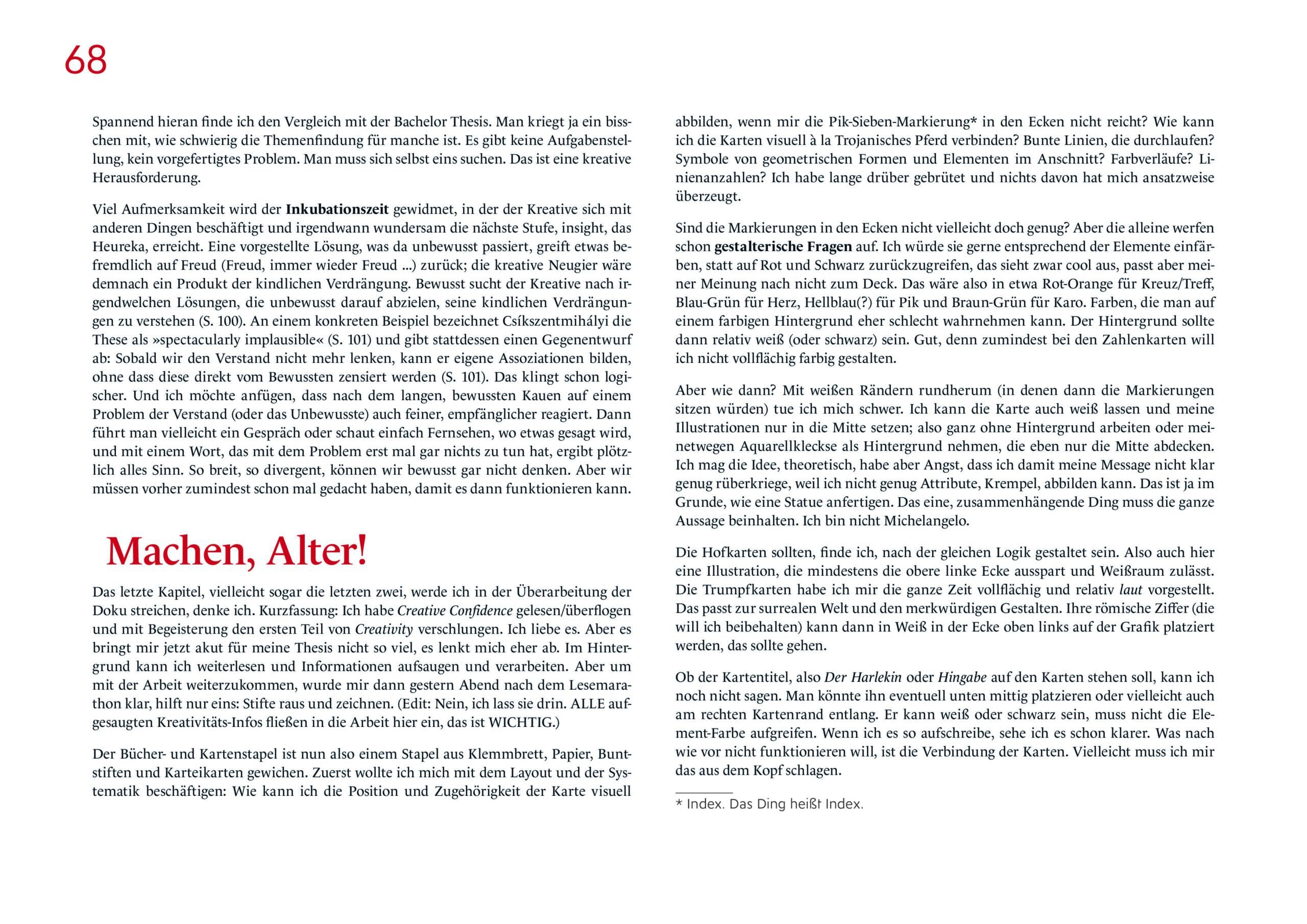
What I find fascinating here is the comparison to the Bachelor’s thesis. You kind of pick up on how difficult it is for some people to find a topic. There is no prompt, no pre-packaged problem. You have to go find one yourself. That is a creative challenge.
A lot of attention is paid to the incubation period, in which the creative occupies themselves with other things and eventually, miraculously, reaches the next stage: insight, the Eureka moment. One proposed solution for what happens in the unconscious falls back somewhat weirdly on Freud (Freud, always Freud …); according to this, creative curiosity would be a product of childhood repression. Consciously, the creative looks for some sort of solution, which unconsciously aims to understand their childhood repressions (p. 100). Using a concrete example, Csíkszentmihályi calls the theory »spectacularly implausible« (p. 101) and offers an alternative concept instead: As soon as we stop steering our minds, they can form their own associations without them being directly censored by the conscious mind (p. 101). That definitely sounds more logical. And I’d like to add that after chewing on a problem consciously for a long time, the mind (or the unconscious) also is more sensitive, more receptive. Then maybe you have a conversation or just watch TV, where something is said, and with a single word that seemingly has nothing to do with the problem at first, suddenly everything makes sense. We can’t even think that broadly, that divergently, on a conscious level. But we have to have done some thinking beforehand for it to work.
* I recently heard this somewhere else in a different form (Angela Duckworth’s Grit??) as a saying from basketball training: »You can’t train height.« That makes sense.
**…..Goethe wrote that in Klärchens Lied.
DSo that was the intro to playing cards and creativity. All the boring research is done and I could start to actualy DO something. Draw for example … Well, let’s wait and see. 😉