

So what is »Creativity«? What is »creative«? What isn’t? And is it possible, that we are all creative? Here’s my first attempt at defining Creativity. And I’m probably starting to go mad.
Turbo!
Yesterday, during a late-night rummy duel, we inaugurated the Shakespeare cards. [Scoll quite far down, there’s a photo of them!!] This morning, I woke up at quarter to six to the sound of the Marseillaise. My first conscious thought of the day was that I desperately need a tricorne hat. It occurred to me as I shuffled from the bed to the kettle, waving my right hand as if leading a marching band. The dogs didn’t march along, because the Marseillaise was only playing in my head.
No wonder—Tarot de Marseille with its carnival-esque figures (the carnival here is heavily influenced by the Napoleonic occupation), and for a few days now, I’ve been watching the (very good!) series adaptation of Les Misérables in the media library, where they sang the Marseillaise.
Over the first coffee, I listened to the Marseillaise, revisited the lyrics, then invented a new national holiday and imagined all the creatures of my Major Arcana participating in the festive parade. By the second coffee, I had to honestly ask myself if my life has always been such a madhouse or if it’s because of the thesis.
It has always been this way.
……New Kids. Turbo! Junge! (I don’t know if they translated the film into English. Watch it in German. Junge!)
Just sit back and let me read this episode to you:
The thesis is just a kind of turbo that amplifies everything and makes it more conscious. And because of it, I allow myself to indulge more in my absurd thoughts. After all, I’m basically fantasizing in the service of science now. And in some wondrous way, my fantasies are manifesting in reality. The invitation to play cards was just the beginning. The other day, a friend told me about a Lord of the Rings marathon with his son. He said he doesn’t usually watch those kinds of movies—yet just after I had made an effort to place Frodo into reality, he’s watching them after all. And this morning, when I walked into reception, there was a huge box of Berliner. Or Kreppel, carnival pastries. As if it were a holiday and we were waiting for the parade. Later, a colleague came in and said something about the Cheshire Cat. It just doesn’t stop. And yet, nobody here knows what I’m doing with my average of 7 hours and 45 minutes of screen time per day. I’m still incubating. The project is Top Secret.
But let’s get down to brass tacks. Earlier at work, I had to upload my documents for Ticket 3 last minute. I simply added the new table to the already formulated concept with the incomplete table of contents. And I’ve felt terrible ever since. Does all the gibberish I’ve come up with and noted down still fit the concept? Can anyone even understand it without having read this long-winded documentation? How on earth am I supposed to make this comprehensible to anyone? Campbell, Odysseus, Count von Krolock … What?
With Ticket 3 the day after tomorrow, the conceptual phase ends. The first six weeks of the Creative Lab will be over. One third. The first act.
So, where do I stand? And where do we go from here?
I’m quite satisfied with my card contents. And I feel like I’ve completed the first act here. Further refining will happen when I start the implementation. You have to be able to leave things alone for a while. Then, later, I’ll design the layout of the cards, and I can decide on the guidebook and its contents. That’s also when the names of the suits/elements will be determined. I’ve noted down »write card profiles«. But it has to rest first. Like dough.
Ideas for styles and visual content have already forced themselves into the conceptual phase, but I’m still pushing them back. I want to see what happens in the design process as impartially as possible.
My notes also say »flesh out the Fool’s Tale«. That ultimately belongs in the second act, at the point when I engage with the card contents again. So, the first act would be almost done. If it weren’t for…
DEFINITION
The Elephant in the Room
And then there’s a big, fat elephant in the room. I’ve paged and browsed through the five or so books on creativity I ordered. I even started reading Csíkszentmihályi. I had searched extensively in the university library and found very, very little that seemed relevant to me. An initial review showed that the texts aren’t helping me right now. The elephant is standing around, looking completely clueless, and nobody is addressing it. What exactly is this creativity everyone keeps talking about, anyway???
Csíkszentmihályi (2013) divides it into three categories, and his book Creativity—or rather the underlying research—deals primarily with what I knew from blog articles and the like as Big-C. Grand breakthroughs, milestones, the level of Nobel Prize winners. According to Csíkszentmihályi (summarized very crudely), this involves not only the creative individual but also the domain in which such creativity is possible and the corresponding experts who validate the milestone (pp. 25-28).
Well, that is precisely not what I’m interested in. And Nobel Prize winners aren’t exactly my main target audience. So, my motivation for reading evaporated quite quickly (though at least I can now spell Csíkszentmihályi without peeking). One of the books I ordered, Creative Confidence, doesn’t appeal to me at all now that it’s sitting here. I don’t want to read it. The others revolve more around art than creativity, which isn’t necessarily my focus either. I had hoped for more insights from—and more motivation for—this research; after all, it’s my core topic!
Well, when I discouragingly restacked the books yesterday onto the pile that had collapsed in the meantime, my whole thesis started to wobble, just like the stack of books and cards. I decided that I first need to define for myself what I mean by creativity—what this fuzzy term is all about for me. Who, according to my personal definition, are these creatives for whom I am designing this deck? Well … Let’s do this.
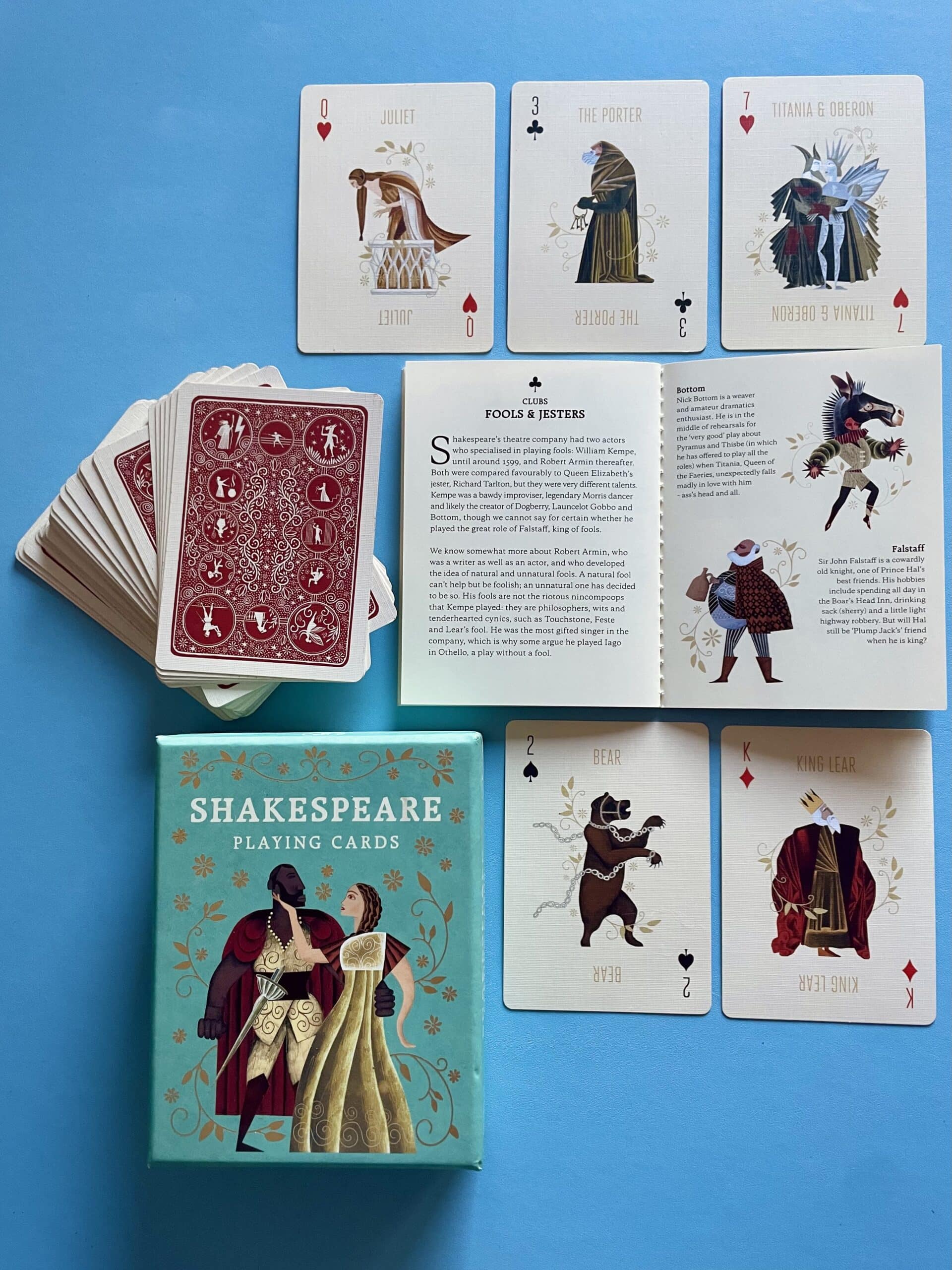
Shakespeare Playing Cards by Adam Simpson, published by Lawrence King. Really beautiful deck!!
Who is creative? What is creative?
Do I consider Nobel Prize winners who put decades into some groundbreaking invention to be creative? Yep. Do I consider someone who paints just for themselves out of joy to be creative? Certainly. And someone who knits socks? Aha. Knitting socks in itself, once you’ve got the hang of it, is completely mindless. In knitting circles, this is called mindless knitting. I (personally!) don’t find that creative; it’s just something to do in front of the TV. But. I classify it as creative (and feel it that way myself) when you first choose the right yarn, imagine the finished project, the combination of yarn and stitch pattern (a cable pattern, for example), and—as most knitters do—make adaptations, like knitting a different cuff that might look good, and so on. If you then set to work with the needles and implement what is, in the end, a very unique, individual design, then in my opinion, it is a creative act that requires creativity.
Knitting a sock according to instructions and a pattern only requires reading and technique. It’s the same as painting by numbers, cooking by a recipe, or assembling a Billy bookshelf: once you’ve understood the basic rules and acquired a certain level of skill through repetition, you can reproduce the result at will without wasting a single bit of attention on it. That can be very relaxing (mindless knitting), and the result can be delightful, but it isn’t creative—in my opinion.
However, I’ve never heard of a knitter who is satisfied with mindless knitting alone or who even manages not to work on several projects with different levels of challenge at the same time. And anyone who cooks with passion certainly uses recipes as a starting point and source of inspiration but will also constantly try out new things. And sometimes they’ll just cook their favorite dish that they know by heart, simply because it’s relaxing, fun, and tastes good.*
These people are, by my understanding, creatives. Just like the tinkering astrophysicist and the simple craftsman who enriches mere craftsmanship with his or her own ideas, individual problem-solving, and, in the best case, personal style. And the storytellers, of course. 😉 Designers anyway. And so many more!
Creativity – defined!
What connects them? And what distinguishes them from those who don’t belong on the list (if they even exist)? Well, first of all, the joy of the activity. Intrinsic motivation (of course extrinsic motivation can be added, for example, if I also get paid for my work). Probably flow states during the activity. But I can also have all of that while riding a motorcycle, which I love, but which I don’t classify as creative, at least not for myself.**
The second connection is that they create something out of their own ideas and visions (something material or even just a tangible concept or solution). For a more correct definition, this something would have to be original (which is also true for this thesis); for that, you need experts who are capable of judging it. If that something provides added value, that would be great too—but I don’t want to include that in my definition because that can be very subjective on a small scale. And I wouldn’t presume to be an expert in anything and judge the originality of my socks, for example.
If we leave out the points that require external validation, what remains is: first, intrinsic motivation; second, joy in the activity; and third, the creation of something from one’s own ideas. This isn’t scientifically tenable, nor is it meant to be. But reading it back, it sounds surprisingly coherent to me: Creatives are people who create something new from their inner drive with their own ideas and become absorbed in their doing. Sounds okay. Joy might be the wrong term after all.
* That’s at least how I imagine it. I just slide frozen pizzas into the oven.
** Maybe I see that differently now.
Are we all creative?
This attempt at a definition includes a lot of people (which is intentional) but also excludes some. I would call the latter mindless, following the knitting analogy, without meaning it maliciously. I suspect that in people who no longer have that inner drive, who no longer produce their own ideas or no longer become absorbed in what they do, something has fallen significantly out of balance. Because when you look at children, you realize that initially (almost?) all humans bring ideas and drive with them and can become absorbed in the process.
I know from my own experience, for example, what depression feels like, and I’ve met many people who are diagnosed as mentally ill. A component of creativity (or all of them) can easily go missing there. And I know plenty of (in this sense, uncreative) people who are considered mentally healthy but whom, based on my personal experience and assessment, I would classify as being out of balance. Take, for example, very jealous or embittered people. There’s no diagnosis there, but I don’t consider them truly healthy, so it doesn’t surprise me when they have no (creative) ideas.
On the other hand, I consider someone with an AD(H)D diagnosis who has learned to manage their deficits to be quite healthy and in balance.
I am not a doctor or therapist; this classification has no medical weight and is purely subjective. It is not meant to exclude or devalue anyone; I have no right to do either. It is only meant to help me personally grasp creativity more clearly and provide a subjective—and therefore processable—answer to the question of why some people are creative and others are not, even though every human being undoubtedly carries creative potential within them.
And what about the insatiable greed? I (as a creative, according to my own super-definition) can relate. My ideas and my urge to realize them drive me from within. Because I become absorbed in my work, lose myself in it, forget the world and time, and work like one possessed. And I love it. I couldn’t exist without it. In that sense, I am highly addicted.
I will present my attempted definition to a few people and ask for their feedback. Perhaps something else will come to light that enriches it. Otherwise, I’ve ordered two more books and am curious to see if I can make friends with them. Because the question remains: are my card contents worth anything in this context? Or will my project collapse like a house of cards after all?
In the next episode I’ll refine this definition of creativity a bit and you can read about the outcome of the mini-survey. But first: What do you think about the definition? Do you consider yourself to be »creative« when you read it? Leave a comment below!


