

Where does inspiration com from and what the f*ck is talent? Does anyone need that? And what about IQ? I’m reading Steven Pressfield’s amazing book The War of Art and draw some conclusions.
Book Review
Yeah! I’ve finished Ticket 3 and, I think, managed to explain my work so far in a coherent way. I’ve got the green light for the next steps.
And now I’ve finally managed to dive deeper into my books on creativity. I decide on Pressfield’s classic The War of Art: Break Through the Blocks and Win Your Inner Creative Battles. It’s small and thin, and you can read it in an afternoon. It had been on my reading list for years. The foreword blows me away: in it, Robert McKee writes that this book is about »Resistance«—the enemy of creativity. McKee equates Resistance with Freud’s Death Wish. And I thought my theory of the inner child against the rest of the world was untenable.*
McKee explains that he and Pressfield disagree on the origin of inspiration; Pressfield, unlike Resistance (which he sees as something genetic and evolutionary), views it as something external, something divine. McKee, on the other hand, locates the origin of inspiration in genetics as well and calls it talent: »the innate power to discover the hidden connections between two things – images, ideas, words – that no one else has ever seen before, link them, and create for the world a third, utterly unique work.« He compares it to IQ and locates inspiration in the unconscious. (Pressfield, 2012, Foreword)
* Really? By now, this is undoubtedly the truth for me.
Here’s the podcast episode:
Parts of the book really grabbed me and reinforced my theses and views on creativity, on being an artist, and on being human in general. And, I’ll admit, I lost focus in some parts. I don’t agree at all with certain things, like the idea that children are born with a fixed identity (p. 145). But, bottom line: the book is absolutely worth reading and reflecting upon.
I’m glad that I gave into the resistance of reading it, and now I it makes sense. The book featured Freud, Jung, Odysseus, Campbell, the Muses, and it also spoke of arenas and critics. There was even a Plato quote about being possessed by the Muses (p. 113).
These are all things that have already been covered, some quite extensively, in this documentation. But I didn’t copy them from a book on creativity (or Tarot); I arrived there via my own detours. The result may be the same, but my detour and its documentation were enormously important to me. I can’t say for sure yet, but perhaps they are the heart of this work.* Sure, that’s why it’s already clocked in at around 164,500 characters. But what I have done and documented is ultimately what McKee calls talent. I’ve drawn connections and made something new out of them. And I can be sure that it is truly mine.
Pressfield’s book reminded me again of how complex and multifaceted the topic of creativity is—if Freud and Plato are involved, it must be a big deal. In the meantime, a thousand other aspects have occurred to me, and I’m still continuing some of the conversations that arose from my mini-survey. No matter how many books on creativity I read or don’t read, or how many people I ask or don’t ask: new aspects will always emerge, and my Tarot will not cover them all or be the Holy Grail for every creative and all their personal challenges.
The good thing is that I can continue to engage with the topic during my further work and even research it beyond this bachelor’s thesis. Maybe one day, following in Freud’s footsteps, I’ll fathom the origin of obsession and write the exorcism book that was requested. Maybe the other books will reveal insights that help me not only theoretically but also quite practically here with my thesis. In any case, I’m now in the mood to read them and am ready for Act 2.
Wanna see what a Muse really looks like?
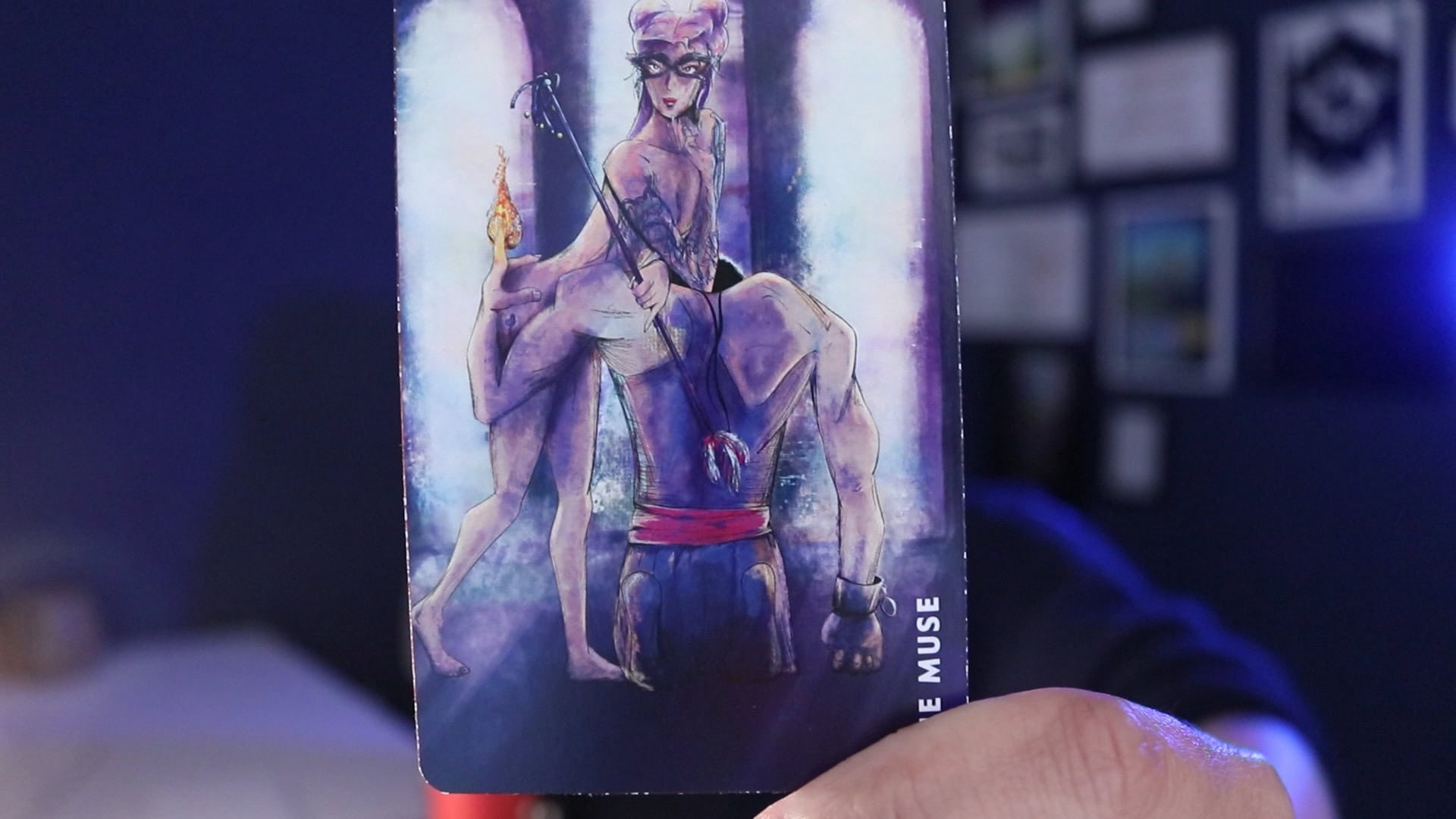
* Yes. They are.
THE WAR OF ART
Pygmalion Effect
For the sake of completeness, one more thing: to quote McKee, I had to use two terms that I had deliberately left out until now. First, IQ (or intelligence), and second, talent. Both crop up sooner or later whenever creativity is discussed.
McKee considers intelligence, which we express as an intelligence quotient (IQ) and can measure via testing, to be hereditary. I looked into this topic extensively a few years ago. According to my state of knowledge, that’s not quite right. I once read that IQ is likely inherited more through the mother, but that environment and upbringing also play their part. There was once an experiment in which teachers were told that children A, B, and C were about to make an IQ jump or something like that (the Bloomers); the teachers acted accordingly and tried to support these students in their development, and at the next testing, the IQ of exactly these students had indeed risen. It’s called the Pygmalion Effect.
As with alcoholism, there seems to be a certain predisposition with IQ—and life takes care of the rest.
Important. It can’t be said often enough. Intelligence is not knowledge or education. Intelligence, as we measure and understand it, is the capacity and thus the speed of information processing. Anyone can solve an IQ test, even my dog. But what counts in the test result (at least for adults; I don’t know about children) is the number of correct answers within a given time.
…….No sources. I find these things in my head. Could be wrong.
TALENT
And now to talent. I hate the term. Sometimes it’s equated with giftedness, which makes it even more complicated; when people speak of being highly gifted, they usually mean an IQ > 130 and not a talent. Additionally, talent and giftedness are often used in connection with creative activities (which in everyday language often means artistic activities). What comes out of all this is a literally indefinable mush: I’m not creative because I’m not intelligent enough, and therefore I have no talent for painting. Or I have artistic talent and am totally creative, but probably stupid because I can’t do math. I’ve heard it all.
In my opinion, you can be creative even without special intelligence. Although higher intelligence probably means more ideas, making creativity perhaps more likely. My understanding is that science has fully understood neither creativity nor intelligence—let alone the connection between the two. Talent and giftedness are even fuzzier. I never considered myself artistically talented. Not even as a child. I hated my pictures because they never met my standards. It’s still that way. And then I see people for whom it seems incredibly easy and who paint incredibly well. Talent? Or have they simply invested much more time than I have?
I’ve found that we like to explain the skills and abilities of others through talent or giftedness. That’s mean, because it probably devalues the other person’s hard work (mastery always involves a lot of work!), and at the same time, I might be closing a door for myself: »I don’t have any talent anyway, so I don’t even need to try«. While simultaneously excusing my less-than-stellar results or my lack of perseverance.
In short: talent and giftedness are even less tangible than creativity, and I don’t want to let them flow into the discussion and this work. I prefer the term inclination. That’s how I eventually defined for myself what others call my talents: things that interest me and that I want to engage with, which leads to motivation and initiative, and in the next seven hundred steps, to me becoming reasonably good at these things—if I stick with them long enough and intensely enough, practicing and refining. None of it has ever felt like talent to me. Nothing.
Intelligence is measurable, but in my opinion, it should be kept out of all discussions that are not explicitly about intelligence, because otherwise, it often leads to misunderstandings.
There may be connections between all of this; I don’t know and won’t pursue it here. My credo is that we are all naturally creative and inspired and that we are free to live out our creativity. What McKee calls talent and the source of inspiration is, for me, the mysterious spark from the Magician, Prometheus, or the fruit tree that drives us humans to think, to create, to strive. I agree with him that it sits within us, somewhere in that great unconscious which, by definition, we cannot truly grasp
So, what do you think about inspiration, about talent and about IQ? I’d love to know if you feel / felt talented in your chosen field of work or art … And how you are dealing with resistance! Leave a comment 🙂
And read Pressfield’s book! The more often I read it, the more I love it.


